Find Optical Table for Lab, Research, and Manufacturing Uses
Source 30 optical table options from verified Chinese manufacturers. Compare specifications including vibration isolation, load capacity, and customization features for laboratory and industrial applications.
Key considerations
Products List










Comprehensive Sourcing Guide
Strategic Sourcing Guide for Optical Tables
Navigating the global market for optical tables requires a disciplined approach that balances technical precision with supply chain reliability. These platforms are not merely furniture; they are foundational components for laser systems, interferometry, and precision metrology where even micron-level vibrations can compromise experimental integrity. The following guide synthesizes observed market data and technical attributes to assist procurement professionals in evaluating potential suppliers and defining precise requirements.
Technical Specifications and Performance Parameters
When sourcing optical tables, the primary focus must be on the physical and dynamic characteristics that ensure stability. The market offers a diverse range of models, from standard static shelves to active self-balancing systems. A critical observation from current product listings indicates that shelf dimensions are often customizable, with standard widths observed at 600mm and heights at 360mm, though buyers must verify if these specific measurements apply to their required configuration. For more complex setups, models such as the ZH and POT series suggest a modular approach, while the LSIS-1 and ZGT Serie indicate specialized applications.
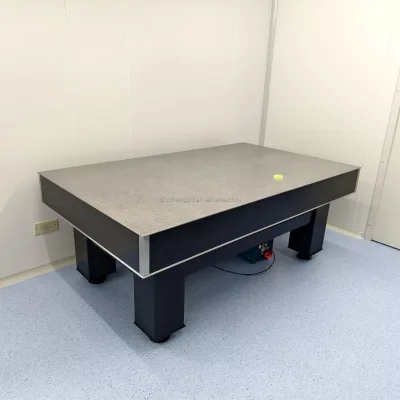
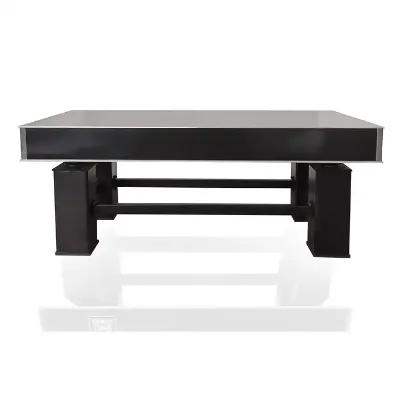
The structural integrity of the table is paramount. Materials vary, with stainless steel being a documented option for specific models, likely chosen for its corrosion resistance and rigidity. Surface finish is another critical technical attribute; observed data points to a surface roughness of 1.6um with a matte finish, a specification that is essential for minimizing stray light reflection in optical experiments. Buyers should verify that the surface treatment meets this roughness standard, as a smoother or rougher finish could impact optical alignment or mounting stability.
Dynamic performance is equally vital. High-end models feature inherent frequencies ranging from 6-8Hz vertically and 6-12Hz horizontally. These figures represent the natural resonance of the table; operating a laser system at or near these frequencies can induce destructive vibrations. Furthermore, the isolation damping type is a key differentiator. Some advanced units utilize porous quasi-laminar flow damping elements, which provide superior stability compared to standard mechanical springs. The vibration isolation structure often involves ultra-thin air springs, requiring a working air pressure between 0.2-0.4MPa. This necessitates that the buyer's facility has a compatible compressed air supply. For active systems, the leveling type is automatic, with re-leveling accuracy specified at +/-0.1mm. This level of precision is necessary for maintaining optical alignment over extended periods without manual intervention.
Compliance, Certification, and Standardization
Ensuring that a supplier adheres to recognized quality management systems is a non-negotiable step in the procurement process. In the observed market, ISO 9001(2000) certification is a documented attribute for certain manufacturers. While this standard indicates a commitment to quality management, buyers should verify the current validity of the certification, as standards evolve. The absence of a specific certification in a product listing does not necessarily imply non-compliance, but it requires a deeper audit of the supplier's internal quality controls.
Product standards vary significantly based on the application. Some listings reference a standard dimension of 1200x800x100mm, while others indicate that the standard is "as per customer required" or "different size and volume." This variability underscores the importance of defining the standard early in the procurement cycle. If a project requires a specific ISO or DIN standard for optical tables, the buyer must explicitly state this requirement, as the default "customized" nature of many listings may not align with rigid institutional standards.
Additionally, the origin of the product plays a role in compliance. Supply chains are observed originating from Nanchang, Jiangxi, and Guangdong, China. While these regions are established manufacturing hubs, buyers should ensure that the specific factory meets international safety and environmental regulations relevant to their own jurisdiction. The presence of OEM (Original Equipment Manufacturer) support suggests that suppliers are capable of adapting their products to meet specific regulatory or branding requirements, but this must be confirmed during the negotiation phase.
Cost Drivers and Pricing Structures
The pricing landscape for optical tables is characterized by extreme volatility, with observed ranges spanning from $50 to $282,400 USD. This vast disparity is driven by several factors, including the complexity of the isolation system, the size of the table, and the level of customization required. A basic shelf unit may fall at the lower end of the spectrum, while a fully automated, self-balancing table with active damping and custom dimensions will command a premium price.
The Minimum Order Quantity (MOQ) is another significant cost driver. Data indicates an MOQ range from 1 to 112,264 units. For a single-item purchase, the unit cost will likely be higher due to the lack of economies of scale. Conversely, bulk orders can significantly reduce the per-unit cost, but the high-end MOQs suggest that some suppliers are geared toward large-scale industrial deployment rather than laboratory procurement. Buyers must clarify the price break structure and whether the quoted price includes shipping, insurance, and customs duties.
Production capacity also influences cost and lead time. A supplier with a stated capacity of 1000 PCS/Month can handle larger orders more efficiently than a smaller workshop. However, high-capacity suppliers may have longer lead times for custom configurations if their production lines are dedicated to standard models. Buyers should request a detailed cost breakdown that separates the base table cost, the isolation system cost, and any customization fees to avoid hidden expenses.
Typical Applications and Use Cases
Optical tables serve a wide array of applications, and selecting the right model depends heavily on the intended use. The "Shelf for Optical Table" suggests a modular component used to expand the workspace of a primary table, allowing for the mounting of secondary optics or detectors. The "Small Combined Table Series" implies applications where space is limited, such as in compact laboratory setups or portable measurement devices.
For high-precision work, the "Self Balancing Optical Table" is essential. These units are designed for environments where floor vibrations are a concern, such as near heavy machinery or in urban settings. The automatic leveling and re-leveling accuracy of +/-0.1mm make them suitable for long-term experiments where manual adjustment is impractical. The "Optical Table" category generally covers standard applications in laser physics, holography, and semiconductor testing.
The material choice, such as stainless steel, is particularly relevant for applications in corrosive environments or where hygiene is critical, such as in medical or biological research. The input voltage of AC110V/220V(60/50Hz) indicates that these systems are designed for global use, but buyers must verify that the specific unit matches the local power grid to prevent damage to the air spring actuators or electronic leveling systems.
Supplier Evaluation and Origin Verification
Evaluating a supplier requires a thorough review of their operational capabilities and geographic location. The observed data points to origins in Nanchang and Guangdong, China. While these are major manufacturing centers, buyers should not assume that all products from these locations are identical. The brand "Chicheng" and "Chicheng photoelectric" appear in the listings, indicating that some suppliers operate under specific brand identities. However, buyers should be cautious of generic listings that may use brand names without official authorization.
The warranty period is a key indicator of supplier confidence. A standard 1-year warranty is observed, which is typical for industrial equipment. Buyers should negotiate for extended warranty terms, especially for complex systems involving air springs and electronic leveling, as these components are prone to wear and tear. The ability to provide OEM support is also a strong indicator of a supplier's flexibility and technical capability.
Packaging is another critical factor in supplier evaluation. Products are observed to be packed in plywood cases, plywood and cartons, or fumigated wooden boxes. The choice of packaging affects the safety of the product during transit. For heavy items with a single gross weight of up to 100kg, a robust plywood case is essential to prevent damage. Buyers should verify that the packaging meets international shipping standards, particularly for fumigation requirements if the wood is not treated.
Quality Control and Inspection Protocols
Quality control (QC) should be integrated into the procurement process from the outset. Given the high precision required for optical tables, visual inspection is insufficient. Buyers should request detailed test reports that verify the surface roughness, inherent frequency, and load capacity. The observed load capacity ranges from 20-100kgs, but this must be validated for the specific model being purchased.
Inspection protocols should include a check of the single package size and weight. For instance, a package size of 63x53x8 cm with a weight of 100kg suggests a very dense, heavy component, while a 90x60x8 cm package with 46kg indicates a lighter, perhaps smaller unit. Discrepancies between the stated and actual weight or dimensions can indicate quality issues or mislabeling.
The color of the table, observed as black or silver, is not merely aesthetic; it can affect thermal properties and light absorption. Buyers should verify that the color coating is durable and does not peel or fade, which could compromise the structural integrity or aesthetic of the laboratory. The process of surfacing, resulting in a 1.6um roughness, should be consistent across the entire surface to ensure uniform mounting and optical performance.
Long-Term Procurement and Maintenance Considerations
Long-term procurement planning involves considering the lifecycle of the optical table. The working air pressure requirement of 0.2-0.4MPa means that the facility must maintain a stable air supply. Any fluctuations in air pressure could affect the leveling accuracy and vibration isolation performance. Buyers should plan for the installation of air filtration and regulation systems to ensure consistent operation.
Maintenance is another critical aspect. The porous quasi-laminar flow damping elements and ultra-thin air springs require periodic inspection to ensure they are not clogged or damaged. The automatic leveling system may require software updates or calibration checks. A 1-year warranty covers initial defects, but buyers should budget for ongoing maintenance costs and the availability of spare parts.
The customization support offered by suppliers allows for future scalability. As laboratory needs evolve, the ability to add shelves or modify dimensions can extend the useful life of the equipment. However, buyers must ensure that the customization process is documented and that the modified parts are compatible with the original system. The production capacity of 1000 PCS/Month suggests that the supplier can handle future expansion orders, but lead times for custom parts should be confirmed.
In conclusion, sourcing optical tables requires a meticulous approach that prioritizes technical specifications, supplier reliability, and long-term operational needs. By carefully evaluating the observed data and verifying critical attributes, buyers can secure equipment that meets the rigorous demands of precision optical applications. The vast range of prices and specifications necessitates a tailored procurement strategy that aligns with specific project requirements rather than relying on generic market assumptions.
FAQs
What customization options are available for optical tables?
Customization is available for shelf width, height, and overall dimensions. Buyers can request specific sizes like 600mm width or 360mm height, or fully customized configurations based on customer requirements.
Which certification do optical table manufacturers typically hold?
Some manufacturers hold ISO 9001(2000) certification to demonstrate quality management. Buyers should verify the current validity of this certification as standards evolve and may require additional audits.
How is the optical table surface finished for optical experiments?
The surface typically features a matte finish with a roughness of 1.6um. This specific finish minimizes stray light reflection, which is essential for maintaining precision in optical alignment and mounting.
Can optical tables be sourced with automatic leveling capabilities?
Yes, self-balancing models feature automatic leveling with a re-leveling accuracy of plus or minus 0.1mm. These systems require a working air pressure between 0.2 and 0.4MPa to function correctly.
What are the standard packaging methods for shipping optical tables?
Products are commonly packed in plywood cases, plywood and cartons, or fumigated wooden boxes. Heavy units may weigh up to 100kg, requiring robust packaging to prevent damage during transit.
Where are these optical tables typically manufactured?
Manufacturing origins include Nanchang, Jiangxi, and Guangdong, China. Buyers should verify that specific factories in these regions meet international safety and environmental regulations relevant to their jurisdiction.
What is the load capacity range for these optical tables?
Load capacity typically ranges from 20 to 100 kilograms depending on the model. Buyers must validate the specific capacity for their chosen unit to ensure it supports the intended experimental equipment.